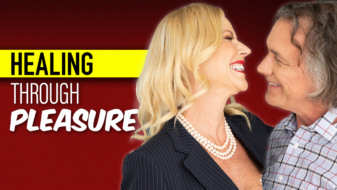
People often feel locked into societal norms, afraid to step outside the box and truly explore who they are. I realized about a decade into my career that my primary role isn’t just teaching, but granting permission. It is about giving people the space to feel more and refusing to be capped by what others expect or demand. When you see someone living by their own rules, it opens a door for you to do the same and trust your own instincts. It is time to stop waiting for external approval and start living your authentic truth.
Full Transcript
[00:00:00]Tim: And literally people have told me this, that they really appreciate that. What we do makes it, they feel like they have permission. To, uh, explore more, feel more, and not be like, you know, like locked into societal norms or capped because they see that there are people that aren’t and they look to us as an example for that.
[00:00:29]Tim: So, uh, that was immediately what came to mind.
[00:00:31]Susan: Yes. I, I realized probably a decade into doing what we do, that my number one job was permission.
[00:00:37]Susan: Mm-hmm.
[00:00:38]Susan: Yeah. So that, that was a good call to, to, to, to speak to that. I was thinking about my daughter, our daughter’s epitaph on her gravestone, which is, I’m doing it.
[00:00:49]Susan: That little girl from the day she was born was self-directed and she was just like, mom, dad, this is what I’m doing. And [00:01:00] that’s because of who we are, because we make up our own rules and we don’t, um, and I’ll tell you another thing that I think really. Created this for me as well, which is that when I was little, my stepfather was the worst offender.
[00:01:17]Susan: My stepmother was the second worst offender in the emotional, sexual physical abuse that I sustained for almost two decades under their collective homes. But, but, um, what was really interesting was that my stepfather was this, this man who was, um, a principal of an all black school. All black elementary school, and he was supposed to be taking care of those children and he would pretend that he was super nice and he was really doing a great job.
[00:01:54]Susan: And he would come home and he would talk about the niggers, the jigaboo, the [00:02:00] jungle bunnies. This is how he would with disgust and hatred. And they would invite him to their churches. And synagogues and they, he would go and my mother wouldn’t go with him, and he would make me go while he was raping me at home, he was making me go to churches and acting like he was this wonderful man, and they were all so nice to him.
[00:02:32]Susan: And what happened was, for me in that paradigm, I realized that that religion was a construct that could be good and could be evil, and it, it had no purchase for me. I sued religion because I associated it with bullshit. And so I, I have always been almost an ardent atheist. Now, [00:03:00] I believe in source, I believe in connection.
[00:03:02]Susan: I believe in Gaia. And I’ll tell you that this workshop that I just came back from was the most I went because my heart has been just so deeply saddened by what’s going on in our country right now. And I have, I, I’m very politically aware and I’m, I’m a very progressive person. My father was a gay man, a closeted gay man.
[00:03:33]Susan: And, you know, so I, I grew up with a closeted gay man. I grew up with a pedophilic liar. So I, I, you know, I grew up with a mother who was the first generation of feminist who raised me to trust myself, believe in myself. She always said. Susan, you know what you’re doing. You know how to make your own decisions.
[00:03:56]Susan: I’ll be here if you need me. Mm-hmm. I’m always your sounding board, but [00:04:00] you know what you are doing. Mm. Don’t let anyone tell you what to do. Don’t let anyone hurt you. You just, and she, she would see my little things I was afraid of. And she would encourage, like, I was afraid to pay for things at the store when I was little.
[00:04:14]Susan: I wasn’t a very fast counter.
[00:04:16]Susan: Mm-hmm.
[00:04:16]Susan: This is my fi, this is my numeric financial coping mechanism. ’cause I suck at numbers, but I have other things I do well. And so she was helping me learn to like, make change and things like that. So she would see where I had weaknesses and she would help. She was, I wasn’t on my own, but she engendered my self-confidence.